2024 marks the 75th anniversary of the founding of the People's Republic of China, a critical year for the implementation of the 14th Five-Year Plan, and an important year for China Foundation for Rural Development (CFRD)'s continuous deepening of its transformation and upgrading.
Guided by Xi Jinping's Thought on Socialism with Chinese Characteristics for a New Era, we continued to implement the spirit of the 20th CPC National Congress and the 2nd and 3rd Plenary Sessions of the 20th CPC Central Committee, and continued to promote the transformation and upgrading of the organization by focusing on the central government's strategy of revitalization of rural areas.
Under the leadership and support of the Ministry of Agriculture and Rural Affairs and the Ministry of Civil Affairs, the organization has strengthened its political leadership, enhanced its credibility and taken the mission of "assisting rural development and promoting common prosperity" as its mission, focusing on underdeveloped regions and low-income groups and actively exploring the organic combination of assistance-based projects and innovative projects, so as to inject an effective impetus for the sustainable development of the countryside.
With the strong support of caring people and organizations from all walks of life, in 2024, the China Foundation for Rural Development accepted a total of 1.13 billion in donated funds and goods, and spent 1.15 billion on public welfare, with various projects benefiting 806 counties with beneficiaries of more than 100 people, and supporting 2,046 villages with more than 50,000 support, and 7.44 million people (time) were benefited from the various projects.
We have always adhered to the four working principles of "focusing on the overall goal, emphasizing sustainability, strengthening demonstrability and building a large platform". Focusing on the five major business sectors of rural industry development, rural talent development, rural construction, rural social undertakings and social mobilization, we have actively explored social resources, innovated application modes, and given full play to the exemplary leading role of social organizations in rural revitalization.
Against the backdrop of the shift in the focus of work related to "Agriculture, Rural Areas, and Farmers", and in the face of the new situation, new tasks and new requirements, we have continued to promote the transformation and upgrading of our work model, and responded accurately to people's new needs of "developing from nothing" to "developing better" among low-income groups in underdeveloped areas. We have gradually transited from implementing direct-assistance projects to overall-development projects, and from implementing projects on our own to partnering with third-party institutions. We will pay more attention to the social benefits of public welfare projects, focus more on the sustainable development of underdeveloped regions, and attach more importance to the endogenous capacity building of the recipients.
In accordance with the overall requirements of the strategy of rural revitalization and based on the positioning of transformation and upgrading, we have been continuously developing innovative projects and optimizing the traditional brand projects. On the one hand, according to the idea of "one transformation" in transformation and upgrading, we have conducted in-depth research on the new needs of underdeveloped areas and low-income population, and have innovated and implemented programs such as the Agricultural Machinery Socialized Service Program, Rural Industry Development Program, New Great Wall Rural Science and Technology Backyard Supporting Plan, Rural Craftsmanship Training Program, and Early Childhood Development Program in an attempt to explore new fields.
On the other hand, we optimized and iterated our existing programs, adjusted their positioning and objectives, upgraded the intervention initiatives, enriched the program contents, and optimized program implementation methods to better meet the needs of beneficiaries. We consolidated and improved the existing advantageous programs such as the Bona Villa Program, Shanpin E-Commerce Agricultural Income-Generation Project, Child Companion Plan Program, Domestic Panda Pack Project, and Doctor Training Program, to make them more targeted, effective, and leading in new rural revitalization practices, and we will make greater efforts to explore new paths for sustainable rural development.
Rural Industry Development
We strive to focus on the revitalization of rural industries and promote sustainable development. The Rural Industry Development Program is making steady progress and improving year by year. In 2024, the cumulative charitable expenditure of the program reached RMB 144 million.
Among them, the Bona Villa Program takes "building demonstration sites, helping industries to become strong, promoting talents to flourish, and assisting organizations in good governance" as its working idea, and carries out rural construction, rural operation, rural governance, and rural talents cultivation to comprehensively promote the revitalization of the demonstration rural villages.
The Shanpin E-Commerce Agricultural Income-Generation Project continued to be inaugurated and put into operation, which produces new projects that help farmers. A number of projects have been completed, including the "Persimmon Future Factory in Wanli Village, Fuping County", which added new vitality to the upgrading of rural industries and pushed local rural industries into a new stage of digitalized production.
The Agricultural Machinery Socialized Service Program introduced a new way of socialized agricultural machinery services in hilly mountainous areas, creating a demonstration model to be replicated and extended to all hilly mountainous areas, so as to enable more farmers to experience and enjoy the benefits of socialized services.
The Rural Industry Development Program, through the initiative of "funds + talents + mechanism", empowers village-level collective economies by allowing them to invest donated funds as shares in county-based agricultural enterprises, and explores new paths to increase the employment and income of farmer households, promote the growth of village-level collective economy, and promote the sustainable development of rural industries.
Rural Talent Development
We focus on the growth of rural talents and help to develop talents for "Agriculture, Rural Areas, and Farmers". In the face of shortcomings and weaknesses of rural entrepreneurial talents and professionalization of farmers' employment, we have extensively gathered resources of scientific research institutes and professional training institutes, and implemented a series of innovative initiatives that take rural talents cultivation as a breakthrough.
The Rural Craftsmanship Training Program provided employment and enabled skill inheritance for native craftsmen, building a strong intellectual foundation.
The New Great Wall Rural Science and Technology Backyard Supporting Plan had in-depth cooperation with a number of colleges and universities to cultivate talents for "Agriculture, Rural Areas, and Farmers", promote the transformation of agricultural science and technology, and promote the development of the agricultural industry.
The Rural Homestay Manager Training Program empowered rural villagers to work in lodgings, upgraded their professional skills and vocational qualities, and promoted the employment and income of villagers in their local communities.
Rural Construction and Disaster Response
We have been actively involved in rural construction and in promoting the implementation of rural programs. We take the initiative to participate in disaster response. We continue to enhance the disaster prevention and mitigation capacity of rural communities and improve the living environment of rural people. In the face of torrential rains and floods in regions, such as Guangdong, Guangxi and Guizhou, we acted swiftly to carry out emergency relief, transitional resettlement and post-disaster reconstruction in a timely and orderly manner.
We continued to follow up the Disaster Prevention and Risk Reduction Program, raise public awareness of disaster reduction and prevention through public service, training sessions and lectures, and enhance the disaster response capacity and development resilience of rural areas. The Comfortable Living Environment Program continues to be carried out, supporting the construction of the "five small projects" with new concepts and new technologies in villages, and the Ant Forest Public Welfare Project continues to expand its implementation scope and improve the rural environment.
Rural Social Programs
We have paid close attention to the development of social causes in rural areas and explored program innovations in a variety of areas. We have continued to provide sustained support for basic public services and livelihood protection programs in rural areas, relating to rural education, children, and health, etc. in order to enhance rural people's sense of security and happiness.
Programs such as the Science Voyage Program and Cheer Up Village Football Program, focused on the needs of rural students for all-round development. The Child Companion Plan Program further enriched the content of its activities and carried out pilot projects focusing on children's mental health and music literacy, helping rural children grow up in an all-round way.
The Doctor Training Program, in response to the current situation and needs of grassroots healthcare, expanded its support from village healthcare offices to three-tiered healthcare organizations in counties, townships and villages, further enhanced the level of grassroots healthcare services after field research. The Elderly Health Care Program continued to conduct research and exchanges, and actively explored effective models for elderly care in villages.
Social Mobilization
We carried out extensive social mobilization and vigorously guided social forces to comprehensively revitalize the countryside. We were actively in building platforms and channels, and played a bridging role to create a strong atmosphere for social forces to participate in rural revitalization.
The NPO Cooperation Program continued to bring in social resources and establish a long-term mechanism for comprehensive promotion of rural revitalization. The ME Innovative Funding Plan for Public Welfare continued to inject development momentum into grassroots social organizations, and continued to guide the flow of social resources to innovative public welfare projects.
We continued to collaborate with a number of online public welfare platforms, and leveraged the power of the Internet to advocate for the public welfare. The One Yuan Donation Program continued to conduct nationwide fundraising activities, and continuously mobilized consumers and compassionate netizens to raise funds for rural revitalization.
The Philanthropic Communication Officer Activities widely mobilized the public to participate in the dissemination of the concept of "public welfare for all", and children born in the 2000s and 2010s started to undertake the important responsibility of public welfare as volunteers for public welfare communication, passing on love and hope to the society.
International Cooperation
With an eye on the international poverty reduction field, we extended international cooperation actively on poverty reduction worldwide. Adhering to the concept of "love without border, people to people connectivity", we responded actively to the "Belt and Road" initiative.
We made an upgrade to the International Panda Pack Project, launched the Sports Pack Program, and organized a series of cultural exchange activities to continuously promote the comprehensive development of the beneficiaries.
The International Smiling Children Feeding Program has continued to play a positive role in eradicating hunger, improving education and promoting employment through comprehensive measures such as supplying food in schools, providing assistance to feeding facilities, and providing jobs etc.
International comprehensive programs such as the Paukphaw Scholarship Program and Water Cellar Program have deepened cooperation with local parties concerned, assisting in safeguarding the right to survival and development of the beneficiaries.
On September 5, witnessed by Premier Li Qiang of the State Council and Prime Minister Abiy of Ethiopia, I will sign a cooperation agreement on public welfare projects with the Office of the First Lady of Ethiopia, which encourages us to further develop international cooperation in poverty reduction and tell the story of poverty reduction in China.
Organizational Development and Self-Construction
We have continued to deepen our self-construction, focusing on improving the overall quality of our team. We have studied and understood General Secretary Xi Jinping's important expositions on "Agriculture, Rural Areas, and Farmers", and organized and carried out competitions regarding the basic policies, basic knowledge and grassroots situation of "Agriculture, Rural Areas, and Farmers", so as to cultivate a professional team that understands agriculture, loves the countryside and loves farmers.
At the same time, we made use of digitalization and AI technologies to manage public resources in a scientific and standardized manner, ensuring that resources were used efficiently for the cause of rural revitalization, and continuously enhancing the credibility and influence of the organization itself.
Through a comprehensive review of plenary session projects, we continued to improve our management and operation system, further standardize project management, optimize the decision-making and implementation process, strictly fulfill the prescribed procedures, and consciously accept the supervision and management from higher authorities and relevant parties.
We will further strengthen our internal audit and control mechanism and improve our "Three Checks and Nine Risks" risk prevention and control mechanism to ensure that all work is carried out in accordance with laws and regulations.
Acknowledgments
We are fully aware that these achievements could not have been achieved without the strong leadership and careful guidance of the Ministry of Agriculture and Rural Affairs, Ministry of Civil Affairs and other relevant departments, or the selfless help and enthusiastic participation of our partners and all sectors of the society, or the close cooperation of the localities where the project is implemented and the full recognition of the beneficiaries. We would like to extend our sincere thanks and high respect to all of them!
Looking Forward to 2025
2025 is the last year of the 14th Five-Year Plan and the last year of the five-year transition period for consolidating and expanding the achievements of poverty alleviation and effective connection with rural revitalization. China Foundation for Rural Development will start a new year with the theme of "quality improvement and development".
We will continue to adhere to Xi Jinping's Thought on Socialism with Chinese Characteristics for a New Era as our guide, further study and understand General Secretary Xi Jinping's important expositions on "Agriculture, Rural Areas, and Farmers", earnestly study and implement the requirements of the "Plan for Comprehensive Revitalization of Rural Areas (2024-2027)" of the Central Committee of the Communist Party of China (CPC) and the State Council, focus on the tasks of comprehensive rural revitalization, strive to give full play to the strengths and roles of our organization, and gather the strengths of all parties with greater enthusiasm and vigour, so as to better enhance the efficiency, effectiveness and effect of our support for rural development, and make new contributions to the comprehensive revitalization of the countryside through practical action!
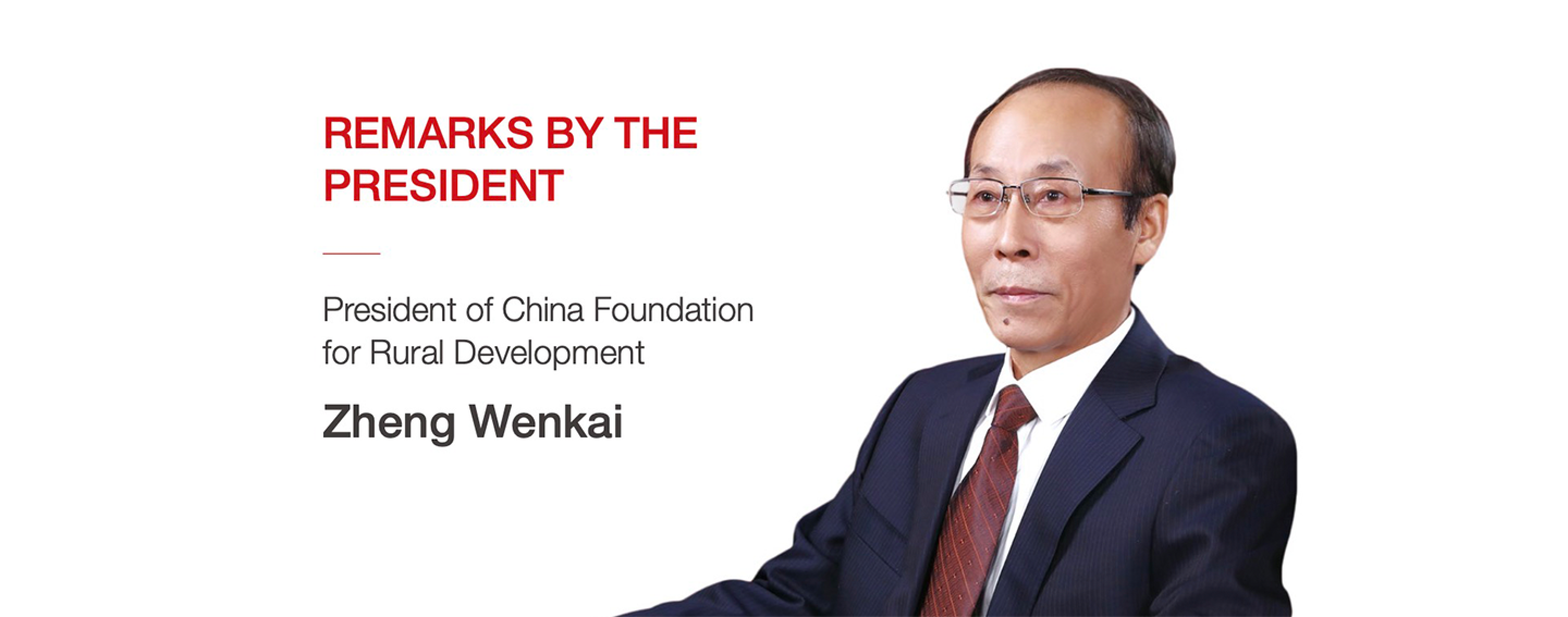
President of China Foundation for Rural Development
Zheng Wenkai